

Artist Bio
“A biography born from experience, not from academia.”
Origins and Early Creative Impulses
René Garruña is a multifaceted visual artist, born in Xalapa, Veracruz, in 1969. His artistic path did not follow traditional academic routes; it emerged instead from personal experience, everyday sensitivity, and a vital need to create. Since childhood, art has been for him a way to understand the world and to sustain himself emotionally through adversity.
His professional training began in public accounting, while his artistic journey was essentially self-taught, born from experience. From an early age, he showed an instinctive bond with creation. Art became his refuge: he transformed kitchen lids into drums, hand-copied the lyrics of artists like José José to sing them, drew magazine characters until he memorized them, and disassembled objects to understand how they worked. He had the fortune — or perhaps the necessity — to invent his own toys: at seven, he was already making spinning tops and wooden cup-and-ball toys on a lathe in a nearby carpentry shop, taking risks that today would seem unthinkable.
He built kites, which he later sold to his neighbors as a response to scarcity, and turned everyday objects into instruments or games. He carved wood, modeled in clay, and recycled materials to give them new life. The creative impulse was always present, even when other responsibilities temporarily pulled him away from a constant artistic practice.
From Craft to Art
For years, music occupied a central place in his life, until health issues forced him to let it go. That necessary renunciation pushed him to redirect his creative energy. Since then, he has explored disciplines such as sculpture, ceramics, sound design, and documentary filmmaking as ways to express his vision of the world.
Clay and the Return to the Essential
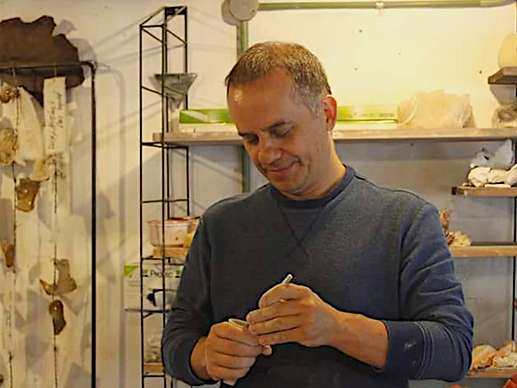
His encounter with clay in 2005 marked a new beginning. Although at that time he held a management position at a private university, the contact with that ancestral material awakened something profound that he could no longer ignore. Since then, art has become a path back to himself — a way of recovering the essential.
Art as a Sincere Quest
Art has become an expansive and irreversible force in his life — not as a fragmented activity, but as a presence that permeates everything. His practice follows not a workshop schedule but a vital pulse that joyfully and determinedly invades every available space. In that quiet devotion, each piece acquires an intimate and authentic value.
His work emerges from reflection, silence, and the desire to understand the human condition. He does not aim to produce in series or follow trends; each piece is the result of a sincere search. He wants art to provoke questions, to move, to leave a trace — to be an experience rather than an object.
He does not see himself as an “artist” in the institutional sense, but as someone who creates because he cannot avoid it. His work is, ultimately, a way to keep a promise alive: to devote himself, more and more, to what truly transforms him.
And perhaps — if someone is reading these lines with an open heart — this story does not belong to a single name, but to a deeper force.
Sometimes, simply, to the Soul and the Spirit.


No busco curarme del mundo,
busco seguir sintiendo en él,
porque resistir no es endurecerse,
es seguir siendo sensible.
Rgs
Artist Statement
“An intimate manifesto about creation, ethics, and freedom”
I create from overflow — from lived experience, from emotion seeking form. I paint as someone who needs to do justice with their own hands, as someone who transforms old wounds into visual language. My starting point is the observation of humanity: its flaws, contradictions, and potential. For me, art is not an escape, but a sharpened sensitivity toward what cuts through us.
Standing before a work in progress is one of the most intense experiences I know. It’s like performing a solo concert — resonating with every color, every shape, every tension. But not everything is pleasure; there is often frustration, doubt, and mistakes that first appear in the mind and are later corrected on the canvas. I don’t move past a section until the brain and the brush have reached agreement — and when that happens, joy arises. Not because it’s perfect, but because it’s honest.
I don’t want the viewer to simply contemplate — I want my work to activate something: a question, a shiver, a reflection, or even discomfort. To me, a piece that provokes nothing, that is met with indifference, is a failed work. I’d rather take the risk of shaking people’s consciousness than settle for the comfort of the decorative.
I'm not interested in building a visual brand or fitting into a market-friendly aesthetic. If today I’m moved to paint a realistic portrait, I will. If tomorrow I’m pierced by an abstract form with no literary narrative, I’ll embrace that too. I reserve the right to surprise — and to change.
As an artist, I don’t owe loyalty to a style, only to my own sensitivity. The only constant in my work is honesty: each piece carries a real dose of who I am — without masks, without formulas.
I paint against the current of time. I know I could be doing other things that generate more immediate income, but nothing compares to the value of creating something that money can’t buy. That’s my real luxury: dedicating my hours to a practice that, even if it doesn’t add up in figures, holds symbolic weight and slowly repays the emotional debts owed to the inner child who always wanted to create — and who now can, with freedom and the gift of maturity.
Once a piece goes out into the world, it no longer belongs to me. It’s like a child you’ve prepared to walk on their own. I don’t try to control it. If it manages to touch someone — even just one person — then it has fulfilled its purpose.
My process is guided by a creative ethic I’ve refined over the years and which crystallizes in the “Arteograma Manifesto.” I conceive of this tool as a kind of artistic electrocardiogram — a way to diagnose the symbolic pulses of a piece, to identify its density and understand how it moves across the spectrum of the technical, the aesthetic, the conceptual, and the cultural. It helps me not only calibrate how a work resonates within me, but also to intuit how it might resonate in society.
The kind of art that interests me is the kind that can move, shake, or even rupture a comfort zone — that opens a space to think, to feel, and, if we’re lucky, to be transformed just a little.